

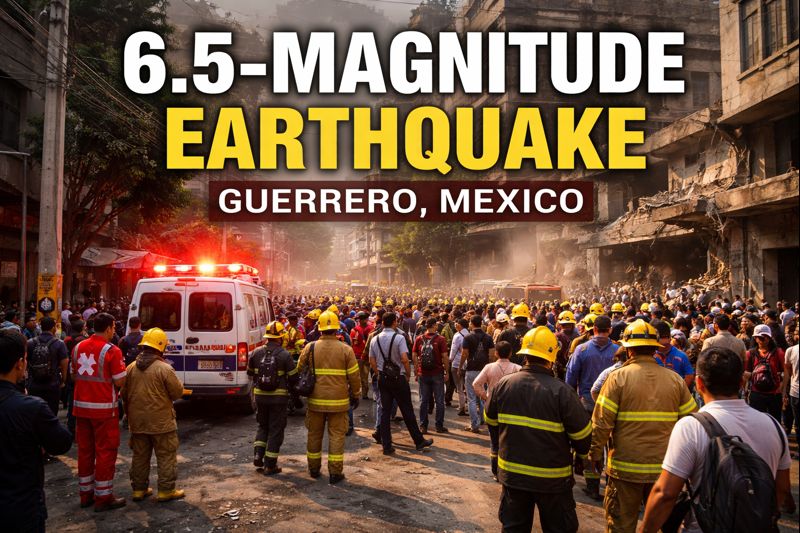
Powerful 6.5 Magnitude Earthquake Strikes Guerrero, Mexico – The giant earthquake that took place in the early hours of January 2, 2026, in southern Mexico, of magnitude 6.5, shook the buildings of various regions and generated seismic alarms in megacities. The quake started at a state known to be highly seismic, namely Guerrero, and was felt up to central Mexico, which includes the capital. Although the tremors were severe, preliminary reports show that there was no extensive destruction or loss of life, even though the authorities are undertaking extensive inspections.
Epicenter and Seismic Characteristics of the earthquakes.
It happened at about 7:58 a.m. in local time, and the epicenter of the earthquake was near a coastal region in Guerrero. The seismological data show that the quake had an intermediate depth of about 35 kilometers, thus resulting in earthquakes that were experienced in a large geographic region without severe devastation on the surface.
A 6.5 magnitude is regarded as strong, and it can wreak havoc on the infrastructure, especially in regions with high populations. Nevertheless, the distance and proximity to large urban centers decreased the possibility of a devastating influence. The residents in southern and central Mexico reported feeling shaking that lasted several seconds.
Table of Contents
Emergency Response Triggers off Seismic Alerts.
The earthquake early warning system of Mexico had been triggered immediately after the quake was recorded. Alerts were aired in various states, including Mexico City, which allowed the residents several vital seconds to exit buildings and find safe grounds. Transportation systems shut down for a short tim,e and emergency processes were implemented in schools, hospitals, and government buildings.
Alarms rang out, and thousands of people were forced to leave offices, residential towers, and commercial areas. The medical services were advanced to inspect the situation and support the at-risk groups. Authorities hailed the alert system as working successfully, which supports the need to use it to reduce injuries during seismic events.
Response and Public Communication by the Government.
The earthquake momentarily paralyzed official government operations in the capital, triggering precautionary evacuations at strategic points. The government was in touch with the citizens soon enough to assure them that there were no reports of extensive destruction of structures or loss of life in the first few hours after the quake.
Rapid assessments of infrastructure, such as bridges, highways, power networks, and hospitals, were done by the emergency management agencies. Local governments in Guerrero and other neighboring states liaised with federal authorities to make sure that the resources were in place in case of any change in condition.
Earthquake in Guerrero, Mexico – Popular Response and Urban Effect.
The residents reported the abrupt swaying of the structures, rattling windows, and toppling of goods on shelves. In other areas, citizens were in the open spaces awaiting official updates. Hospitals were transferring patients outside momentarily as a safety measure and traffic was reduced with people pulling over during the shocks.
There were real-time responses, videos, and photos of evacuations, emergency drills on social media. Though these scenes seemed to be dramatic, the authorities explained that these scenes were part of the preventive precautions and not evidence of serious damage.
History of Seismic Activity by Guerrero.
Guerrero is located at a significant tectonic boundary where the Cocos Plate is sliding below the North American Plate, and hence, it is one of the most seismically active areas in Mexico. The region has had a lot of major earthquakes over the years, and therefore, there has been constant investment in seismic surveillance and population preparedness.
Read Also – 5 Key Insights on Lalit Modi: MEA’s Commitment to Repatriation Efforts
The building requirements, fire warning mechanisms, and emergency management plans in the region have greatly changed and are no longer as vulnerable as they used to be in the past. This earthquake again proved the importance of preparedness in the high-risk areas.
Subsequent shocks and Continuous Evaluations.
After the principal quake, the authorities started to observe aftershocks that are usually the result of such big earthquakes. Smaller tremors should be expected, but the authorities recommended that the residents should be watchful of their surroundings and stick to safety measures, especially in the old buildings.
Inspection teams are still investigating buildings to detect any concealed structural stress that is not easily seen. Essentials like utilities and communication services were also not much affected, and no reported long-term outages.
Significance of Preparedness to Earthquakes.
This earthquake is used to remind of the significance of earthquake preparedness in the prone areas. Early warnings, emergency drills, and awareness of the people are very important in minimizing risk and saving lives. Professionals advise residents to watch evacuation plans, stabilize furniture and have emergency kits.
Conclusion
The 6.5 magnitude quake in Guerrero was a strong but not frightening, anger reminder of the geological fact of Mexico. The effect was minimized due to the efficient alert mechanism, emergency response, and people’s cooperation. Constant attention, infrastructure strength, and disaster preparedness are critical in protecting communities in case of seismic events in the future.






[…] Read Also – 6.5-magnitude-earthquake-strikes-guerrero-mexico […]