

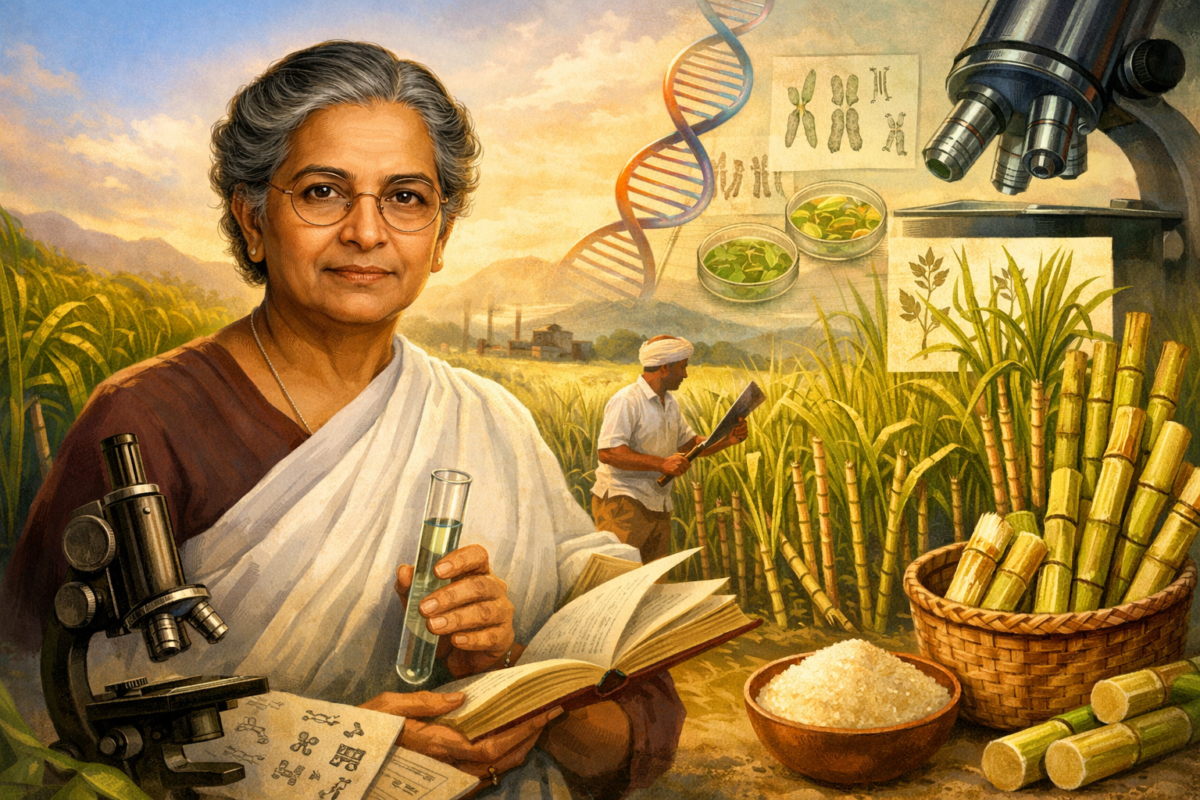
Janaki Ammal: First Indian Woman to Receive a PhD – Scientific history in India is plentiful in innovators, but most of the most striking ones have not been fully recognized. Among these towering personalities is Edavalath Kakkat Janaki Ammal, who was the pioneer botanist and cytogeneticist whose work changed the face of Indian agriculture. Janaki Ammal was known to be the first woman in India to receive a PhD in botany, which had a decisive influence in enhancing the variety of sugarcane so that Indian sugarcane could be sweeter, stronger, and adapted to the local conditions. Her biography is that of perseverance, genius, and silent revolution.
Childhood and Educational Background.
Janaki Ammal was born on November 4, 1897, in Thalassery, Kerala, in a family that treasured learning and intellectual autonomy. She was also very much interested in plants and nature even as a young child. Academics were a rarity for women in an era when women were not expected to be ambitious in their education.
She graduated with an undergraduate degree in botany at Queen Mary College in Madras and eventually got honours degree at Presidency College. It is her academic quality that provided a solid background to her legendary scientific career, against all the societal demands to women in early 20th-century India.
First Indian Woman to Receive a PhD in Botany.
The search of higher education by Janaki Ammal led her to the United States, where she enrolled in the University of Michigan. She was a specialist in cytology, the study of cells and chromosomes, a new field of study in those days. She obtained her PhD in the year 1931 and was among the first Indian women to do so in the sciences.
This was not only a personal accomplishment but it was also a historic event to Indian women in the field of higher education and research. Her research into the plant chromosomes would later turn out to be the focus of her research into agricultural science.
Table of Contents
Science in transforming Indian Sugarcane.
After coming back to India, Janaki Ammal was invited to the Sugarcane Breeding Institute in Coimbatore, where she conducted research that would transform the sugar production in India. The varieties of sugarcane used in India during the period were quite strong but had no high sugar content, and India had to depend on imported varieties.
Through cytogenetics and plant hybridisation methods, she researched the chromosomal composition of sugarcane and other species of grasses. Her findings indicated that the variation of combinations of the chromosomes affected yield of sugar, resistance to disease, and adaptability.
Read Also – 5 Key Insights on Lalit Modi: MEA’s Commitment to Repatriation Efforts
Among her greatest contributions was the recognition and application of native sugarcane species to create high-yielding and sweeter species that were adapted to Indian climates. This production minimized the reliance on international strains, enhanced the productivity, and empowered the independence of India in sugar production. The Indian sugarcane is very sweet, and, in large part, this is due to its scientific understanding.
International Reputation and Research Quality.
Although there was gender bias in India, the experience gained by Janaki Ammal was highly appreciated across the world. She was employed in the United Kingdom, where she worked in the major research institutions of horticulture and genetics during the 1940s. It was there that she worked on one of the most valuable botanical reference books of the period, a complete atlas of the number of chromosomes of the cultivated plants.
Her work was known all over the world and some plant varieties were called after her, which can be regarded as one of the examples of her impact on botanical science. The collaborations with the international organizations strengthened her image of an international scientist in plant genetics.
Back to India and Botany and Leadership.
Janaki Ammal returned into India in the post-independence period to assist in restructuring the Botanical Survey of India. She enhanced botanical studies, recording of native plants, and protection of the same countrywide.
In addition to her work in laboratories, she was also very passionate about environmental conservation. She was an active advocate of conserving delicate ecosystems such as forests in Kerala way before environmental conservation became a popular trend in India.
Awards, Recognition and Long-lasting Legacy.
Janaki Ammal was honored by being awarded Padma Shri in 1977 in terms of her weighty contributions. But her most important impact is not awards but the long-term effect of her work. Her influence on the scientific and ecological life of India is still evident today, with the advancement of better agricultural methods and the creation of the best scientific institutions. She died in 1984, and she left a legacy of innovation, boldness, and service to society.
The Reason Janaki Ammal Matters Today.
The story of Janaki Ammal is more topical than ever. She symbolizes the strength of science to change the ordinary life of the sugar we drink and of the crops that feed millions. She is also a hero to women in the STEM field, as she shows that determination and intelligence are more than enough to break down the systems.
Her works remind us that there is a lot of quiet brilliance behind the most basic things that we have known to be comfortable, and that there were scientists who were bold to break the rules and rewrite the future – one chromosome at a time.
