

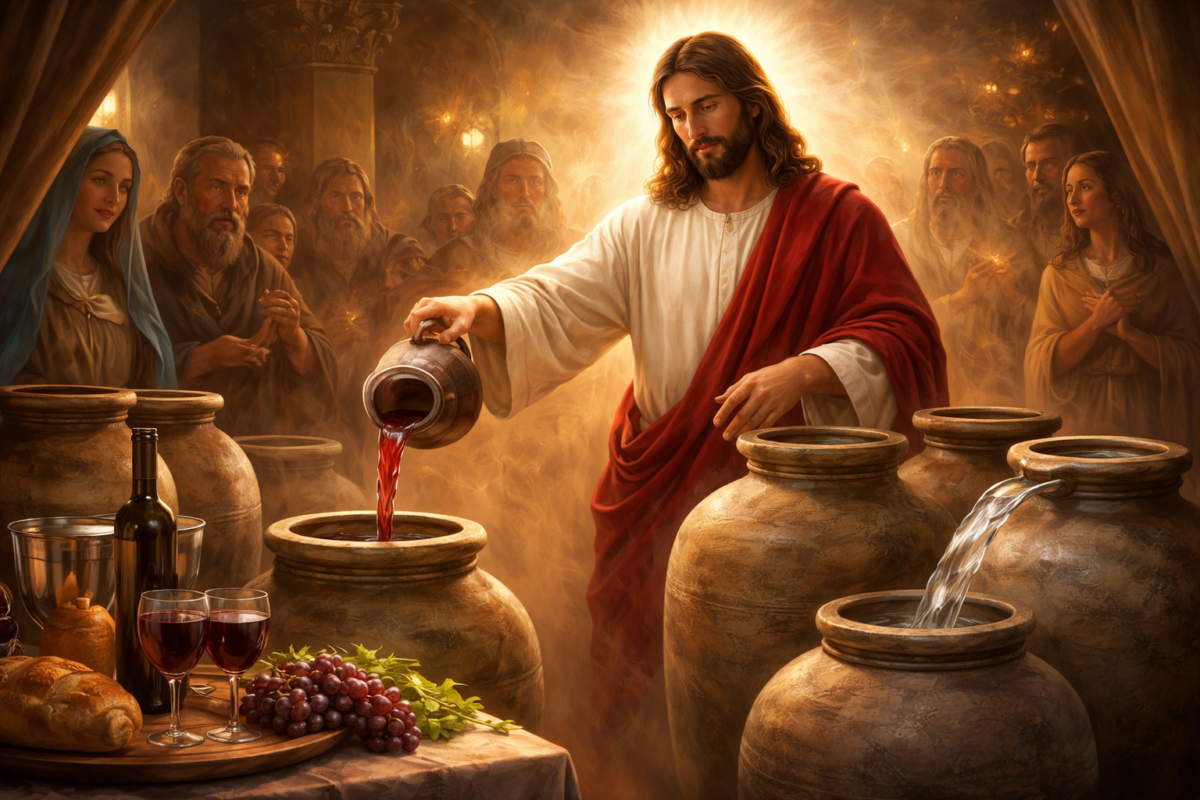
First miracle that Jesus performed in front of the crowd – One of the most popular and widely discussed miracles that are described in the Christian tradition is the story of Jesus turning the water into wine. It has been a justification of faith, curiosity and discussion over centuries, as it is often thought to be the first miracle that Jesus performed in front of the crowd. Whereas the believers view it as a strong intervention of God, other people take the account with a scientific attitude, questioning whether such transformation can be attained in accordance with the law of nature. Discussing these two views and understanding their presence in different generations allows to further understand the value of this story to this day.
Jesus first miracle – The Biblical Incident Decoded.
The story recounts a wedding party that had almost ended when its organizers ran out of wine. Jesus, in his turn, ordered servants to fill big stone jars with water. By the time the water was subsequently drawn out it was wine of considerable quality. The miracle itself is not the only meaning of the event but the symbol of abundantness, mercifulness, and reveling of divine power.
This scene has always been seen as a mark of change and divinity as opposed to mere exhibition of power.
Table of Contents
Science behind Jesus miracles about Wine.
Scientifically, wine is not a rather simple substance. It is a complicated blend mainly made up of water yet containing alcohol, organic acids, sugars, minerals and hundreds of aromatic substances. The components are formed by a clear biological process known as fermentation in which the sugar that is present in grapes is changed to alcohol by the yeast as time goes by.
Pure water on the other hand does not have any of the necessary components to undergo fermentation. It contains no sugars, no yeast, no organic substances which can naturally develop into wine without the additions.
Water to wine scientific explanation with science?
Chemical Limitations
It has been demonstrated by modern chemistry that water is only a mixture of oxygen and hydrogen molecules. To convert it into wine would involve the immediate formation of carbon-based compounds, alcohol and more complicated organic molecules. This kind of transformation can never take place by normal chemical reactions.
One such theoretical notion is nuclear transmutation whereby elements are changed into other elements. But this process requires enormous amounts of energy and regulated surroundings which would be disastrous and unattainable in a natural situation such as a wedding feast.
Laboratory Experiments vs. Reality.
There are demonstrations in which liquids are put into play to transform color or look, as an illusion of wine. These experiments do not however produce alcohol or mimic the chemical composition of real wine. These are not real changes but visual codes.
Even sophisticated science processes need time, raw materials, and biological agents. The immediate change of water into wine is still well beyond the established scientific ability. The reason is why the two come to different conclusions: science and faith.
Read Also – How a YouTube Indian AI Channel Is making Millions per year
The Scientific Approach
Science relies on observation, experimenting and replicability. Such events are testable or reproducible and therefore they are beyond its scope. In this way, science neither confirms nor denies miracles it just cannot prove them by the existing means.
In this sense, the story of water-to-wine cannot be attributed to the established physical, or chemical, laws.
Miracles are interpreted in the religious faith as a way of going beyond natural laws. They should not be subject to scientific principles but are to be accepted as manifestations of the will of God. It does not matter what the mechanics are but the meaning behind the event.
The symbolic interpretation of the miracle by many theologians is a symbol of transformation, renewal and the beginning of a new spiritual covenant, and not a literal scientific event.
Context Matters: Historical and Cultural.
The fact that this is written at the time that was happening and the culture of that era enriches the story. Wine played a significant role in the life of the ancient societies in social and ceremonial life. There was no easy way of ending up with no more wine at a wedding and this was a grave embarrassment and thus the provision of wine was even more meaningful.
Also, interpretations on history have been disputed on what the wine that was referenced was, with the use of the term in ancient lingo occasionally being general referring to fermented or unfermented drinks made out of grape.
Intersection of Science, Symbolism and Belief.
Science and religion tend to answer various questions. Science is interested in how things occur whereas faith is interested in why they do. The water-to-wine story is at this point and is an invitation to reflection, but not to experiment.
To scientists, the occurrence cannot be explained using existing natural laws. It is an effective symbol of divine compassion and change to the believers.
Conclusion: More Than a Scientific Question.
Whether water can be transformed in wine, or not, is a matter of opinion and not the chemistry of it. Such a transformation has no scientific explanation. It has a spiritual significance of hope, abundance and transformation.
This is the most powerful story because it makes us ask questions about faith and reason and it makes us remember that not everything that is true can be quantified in the laboratory- some is perceived by faith, culture and sense.