

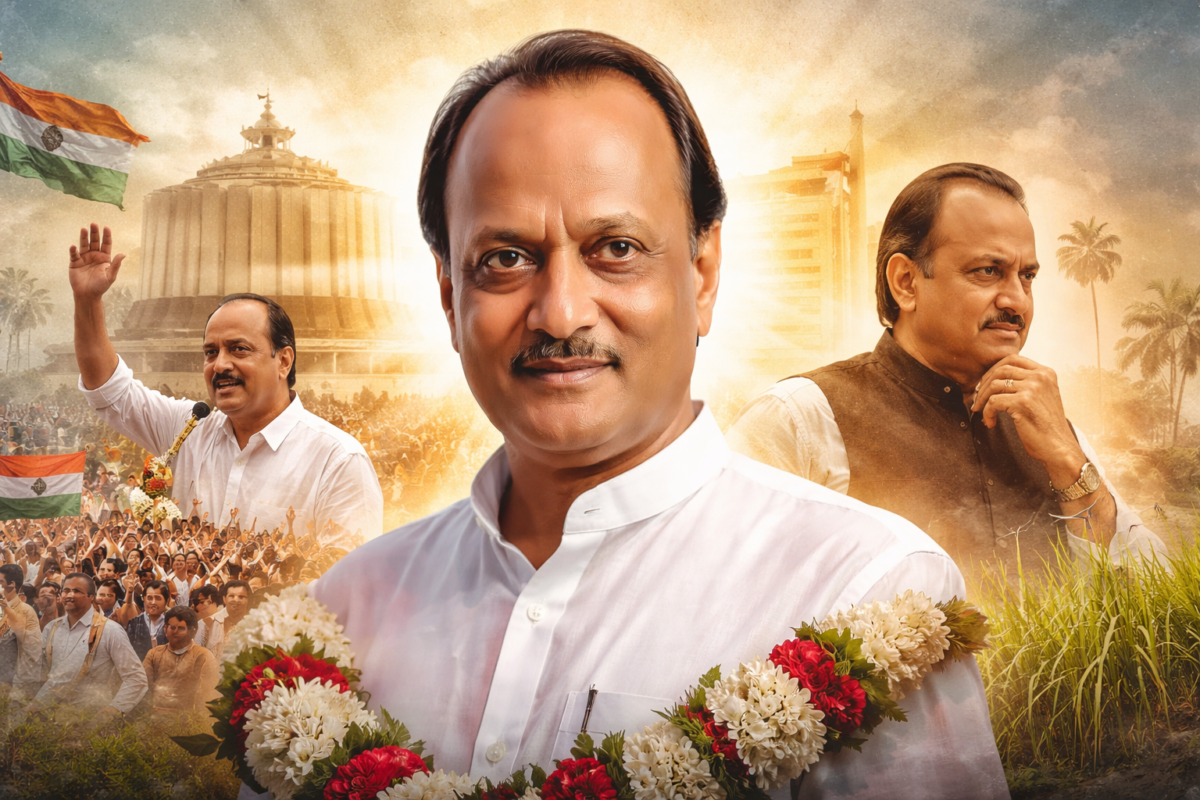
Explore Ajit Pawar’s political journey, leadership legacy, rise in Maharashtra politics, and the impact of his sudden demise on state governance. The life and political journey of Ajit Anantrao Pawar (1959–2026) stands as one of the most influential chapters in Maharashtra’s modern political history. Known for his sharp administrative skills, deep grassroots connection, and bold political decisions, Ajit Pawar evolved from a regional leader in Baramati to a decisive power broker in state politics. His sudden demise in a tragic plane crash marked the end of an era and left a profound impact on the political landscape of Maharashtra.
Ajit Pawar – Early Life and Roots in Rural Maharashtra
Ajit Pawar was born on 22 July 1959 in Deolali Pravara, Maharashtra. Coming from a family deeply involved in public life, responsibility arrived early for him. The loss of his father at a young age shaped his resilience and instilled a strong sense of duty toward society.
Rather than entering politics through privilege alone, Pawar began his journey at the grassroots level. He actively participated in the cooperative movement, a powerful socio-economic force in rural Maharashtra. His early work with sugar factories and cooperative banks helped him understand the challenges of farmers, laborers, and rural communities, forming the backbone of his future political identity.
Table of Contents
Entry into Politics and Rise Through Cooperatives
Ajit Pawar’s rise was steady and rooted in organizational strength. In the early 1990s, he assumed leadership roles in cooperative institutions, including the Pune District Central Cooperative Bank, where he served for several years. This position strengthened his administrative reputation and expanded his influence across western Maharashtra.
His electoral journey gained momentum when he entered legislative politics from Baramati, a constituency that would become synonymous with his leadership. Pawar’s ability to combine development-focused governance with strong voter engagement ensured repeated electoral victories, making Baramati one of the most politically stable regions in the state.
Governance, Portfolios, and Administrative Influence
Over the years, Ajit Pawar handled some of the most critical portfolios in the Maharashtra government. These included Finance, Water Resources, Irrigation, Rural Development, and State Excise. His command over budgetary planning earned him recognition as one of the most hands-on finance administrators in the state.
He played a crucial role in shaping irrigation projects, rural infrastructure, and welfare schemes. Supporters praised his decisive leadership and execution-driven approach, while critics often viewed his style as assertive and uncompromising. Regardless of perspective, his impact on governance was undeniable.
Deputy Chief Minister and Political Strategist
Ajit Pawar served multiple terms as Deputy Chief Minister of Maharashtra, making him one of the longest-serving leaders in that position. His ability to manage coalition governments and navigate political instability highlighted his strategic acumen.
One of the most defining moments of his career came when he made a dramatic political realignment that reshaped Maharashtra’s power structure. This move reinforced his image as a pragmatic leader who prioritized influence and governance over ideological rigidity. It also positioned him firmly as a central figure in state politics.
Baramati’s “Dada” and Mass Appeal
In Baramati, Ajit Pawar was more than a politician — he was “Dada,” a leader seen as approachable yet authoritative. His development-oriented initiatives, focus on education, irrigation, and employment, and constant engagement with local communities earned him unwavering loyalty.
His mass appeal extended beyond party lines. Even political opponents acknowledged his organizational strength and deep understanding of regional dynamics. This unique blend of authority and accessibility defined his political persona.
Tragic Plane Crash and Sudden Loss
On 28 January 2026, Ajit Pawar’s life came to a tragic end when the aircraft he was traveling in crashed while attempting to land in Baramati. The accident resulted in the loss of all onboard, including Pawar, sending shockwaves across the nation.
The tragedy occurred while he was en route to attend political and public engagements. Investigations were immediately launched to determine the cause of the crash. His sudden passing left supporters, colleagues, and citizens in disbelief.
Nationwide Mourning and Political Reactions
The news of Ajit Pawar’s death triggered widespread mourning across political parties and social groups. Leaders from across the spectrum paid tribute to his administrative skills, dedication to public service, and unmatched political instincts.
Messages of condolence highlighted his role in strengthening rural governance, empowering cooperative institutions, and shaping Maharashtra’s fiscal policies. His absence was widely described as a major void in state leadership.
Read Also – What is UGC? UGC Bill 2026: All you need to know about
Legacy and Impact on Maharashtra Politics
Ajit Pawar’s legacy is complex yet powerful. He was a reformer, strategist, administrator, and mass leader rolled into one. His decisions influenced political alliances, governance models, and electoral strategies for years to come.
While debates around his political choices will continue, his contribution to Maharashtra’s development and political evolution remains undeniable. His life story reflects ambition, adaptability, and an unwavering grip on power rooted in grassroots strength.
Conclusion
Ajit Pawar’s journey from a cooperative leader to one of Maharashtra’s most influential political figures is a testament to strategic leadership and resilience. His sudden death in the Baramati plane crash ended a towering political career but cemented his place in history.
As Maharashtra reflects on his life and legacy, Ajit Pawar will be remembered as a leader who shaped an era — decisive, influential, and deeply connected to the people he served.