

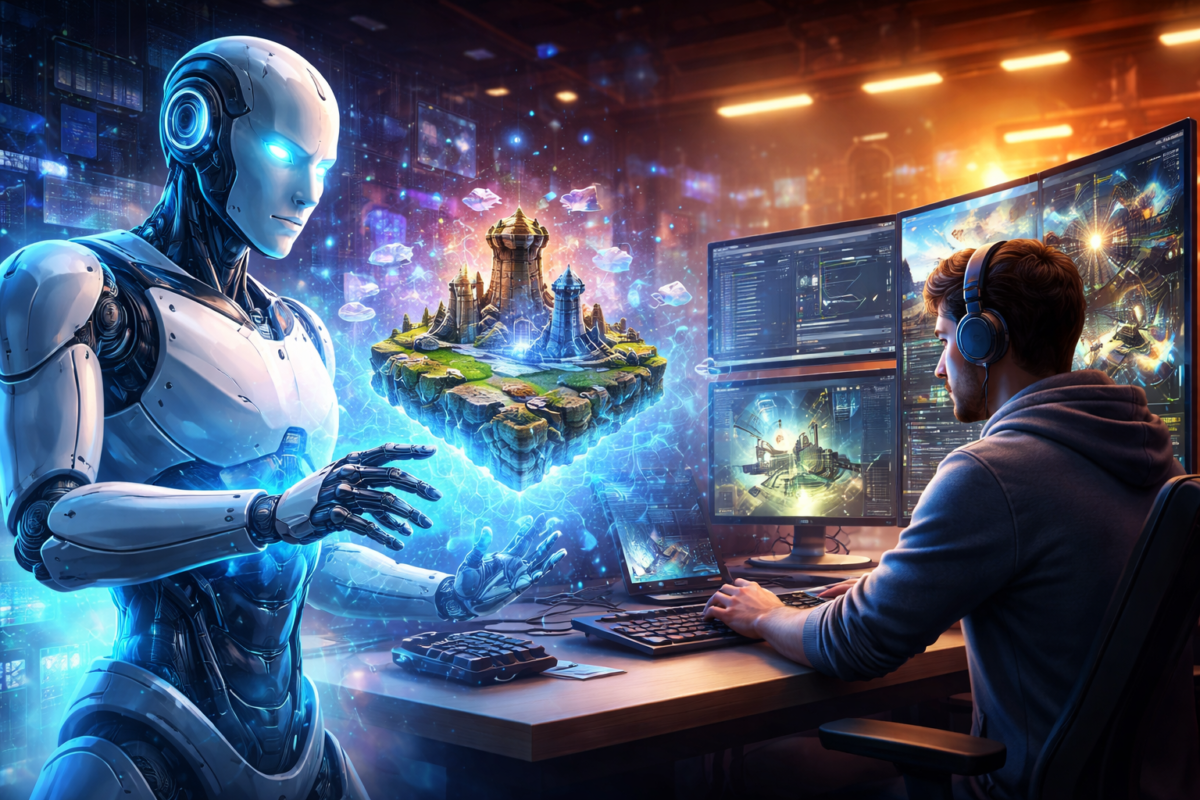
Will AI replace game developers in 2026? Explore how artificial intelligence is transforming game development and why human creativity remains essential in the gaming industry. Artificial Intelligence (AI) is rapidly transforming many industries, and the gaming sector is no exception. From assisting with coding to generating visual assets and testing gameplay, AI has started to play a significant role in the development of modern video games. As these technologies evolve, many people are asking an important question: Will AI replace human game developers by 2025?
While AI is becoming a powerful tool in game creation, the reality is far less dramatic than some headlines suggest. Instead of replacing human developers, AI is more likely to become a supportive technology that helps developers work faster, smarter, and more creatively.
Game Developers – The Growing Role of AI in Game Development
Over the last few years, AI-powered tools have become increasingly popular among game studios. Developers are using these tools to automate time-consuming tasks and improve efficiency throughout the development process.
AI can assist with generating game environments, creating textures, identifying bugs, optimizing performance, and even helping with coding suggestions. By automating repetitive work, developers can spend more time focusing on creative elements such as gameplay design and storytelling.
As development cycles become more complex and players expect higher-quality graphics and immersive experiences, AI helps studios keep up with these demands while managing costs and time.
Table of Contents
Why Human Creativity Still Matters
Despite the capabilities of AI, game development remains deeply rooted in creativity and imagination. Designing a game involves much more than writing code or generating visual assets.
Developers must build engaging worlds, create memorable characters, design unique gameplay mechanics, and craft stories that emotionally connect with players. These aspects require human insight, cultural understanding, and artistic vision.
AI may be able to generate ideas or assist with certain tasks, but it cannot fully replicate the creativity and emotional depth that human developers bring to a project. The most successful games often emerge from passionate teams who combine technical skills with storytelling and artistic creativity.
How AI Is Helping Developers Work Smarter
Rather than replacing developers, AI is becoming a powerful assistant that improves productivity across different stages of game development. Many studios already use AI-based tools in their workflow.
Faster Game Prototyping
AI can help create early prototypes quickly by generating environments, characters, or gameplay elements. This allows developers to experiment with ideas and test concepts much faster.
Procedural Content Creation
Procedural generation allows AI to automatically create large environments, landscapes, or minor assets. This saves countless hours for artists and designers while still allowing them to refine and personalize the final result.
Automated Game Testing
Testing video games manually can require enormous amounts of time. AI-driven testing tools can simulate gameplay scenarios, identify bugs, and detect performance issues faster than traditional methods.
Supporting Writing and Dialogue
Some developers also use AI tools to brainstorm dialogue ideas or generate early drafts for scripts. These tools help writers overcome creative blocks and speed up the writing process.
Overall, AI is proving to be most effective when it supports human creativity instead of replacing it.
Concerns About Job Security
As with any new technology, the rise of AI has created concerns about potential job displacement. Some developers worry that automation could reduce the need for certain roles, particularly tasks involving repetitive asset creation or simple coding work.
Entry-level roles in areas like background art, basic animation, or routine programming tasks may see some changes as AI becomes more capable. However, this does not necessarily mean fewer jobs in the long run.
Instead, job roles are likely to evolve. Developers may shift their focus toward more advanced tasks such as game design, system architecture, storytelling, and player experience. As technology advances, new types of jobs in AI-assisted game design may also emerge.
The Risks of Relying Too Much on AI
While AI can increase efficiency, relying too heavily on it can create problems. Games that depend excessively on AI-generated content may feel generic or repetitive.
Players often value originality, artistic style, and emotional storytelling. If too much of the content is generated automatically, it can lack the uniqueness that makes games memorable.
Human oversight is essential to ensure quality, consistency, and creativity. Developers must carefully balance AI assistance with human creativity to produce engaging and meaningful experiences.
AI and Human Collaboration in the Future
Many experts believe that the future of game development will involve close collaboration between humans and AI systems. Instead of replacing developers, AI will function as a powerful tool that expands what creative teams can accomplish.
By automating repetitive tasks, AI allows developers to focus more on innovation and experimentation. Smaller studios may also benefit, as AI tools can help them produce high-quality games with limited resources.
In this way, AI acts less like a replacement and more like a “creative assistant” that helps developers bring their ideas to life faster and more efficiently.
The Future of Game Development
Looking ahead, AI will continue to become a standard part of the game development process. Tools powered by machine learning will keep improving and may eventually assist with complex design decisions, player behavior analysis, and world-building.
However, the essence of great games will always come from human imagination. Storytelling, emotional connection, and artistic creativity remain areas where human developers excel.
Read Also – God of War Greek Trilogy Remake Sons of Sparta PS5 Launch
Rather than replacing people, AI is more likely to reshape the way games are made, enabling developers to create bigger, more immersive, and more innovative gaming experiences.
Conclusion
The idea that AI will completely replace human game developers by 2025 is unlikely. While AI is becoming an important part of the development process, it still depends heavily on human creativity, direction, and expertise.
Game development is both a technical and artistic discipline. AI can handle repetitive tasks and improve efficiency, but the vision behind successful games will continue to come from talented developers and creative teams.
Ultimately, the future of gaming will be shaped not by AI alone, but by the powerful collaboration between human creativity and advanced technology.