

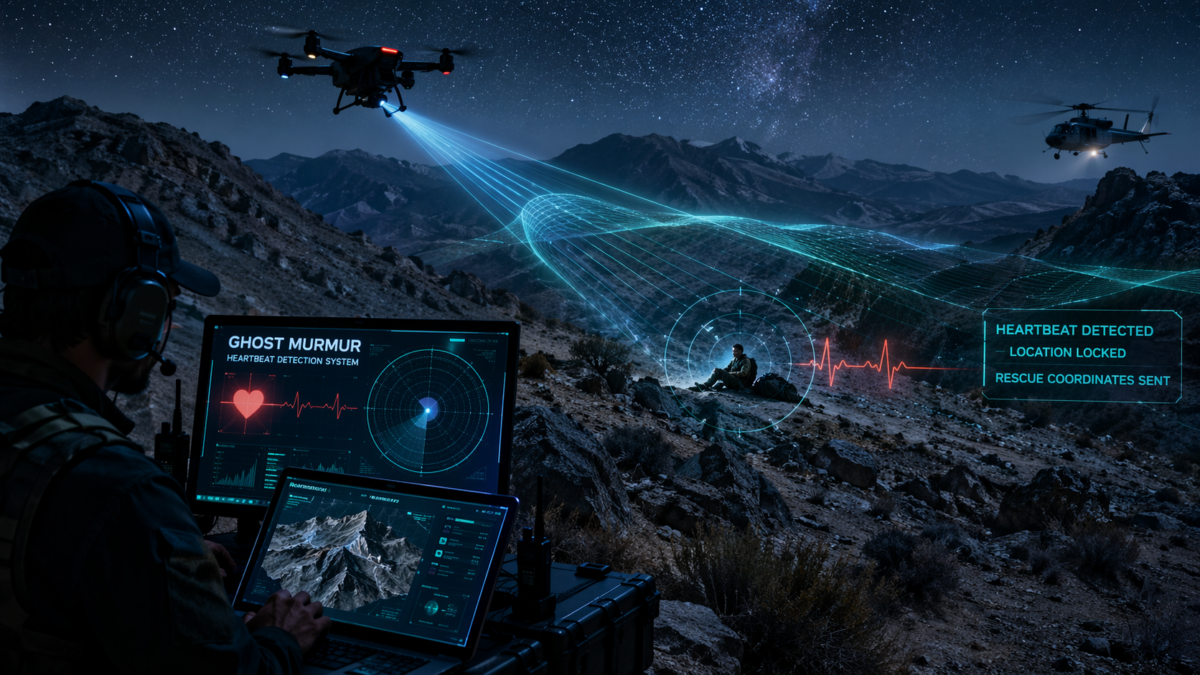
Discover Ghost Murmur, the advanced heartbeat detection technology revolutionizing rescue missions and surveillance with AI-powered precision in extreme conditions. In the world of advanced intelligence and covert operations, new technologies often remain hidden from the public eye—until a breakthrough moment brings them into focus. One such innovation is Ghost Murmur, a highly classified system that has recently gained attention for its role in locating a downed pilot in hostile territory.
This cutting-edge technology is believed to represent a major shift in how rescue missions and surveillance operations are conducted. But what exactly is Ghost Murmur, and why is it being described as a game-changer?
What is Ghost Murmur?
Ghost Murmur is an advanced surveillance system designed to detect human presence by identifying subtle biological signals, particularly the electromagnetic activity produced by the human heart.
Unlike traditional tracking systems that rely on GPS devices, communication signals, or thermal imaging, Ghost Murmur focuses on the body’s natural rhythms. The concept is simple yet groundbreaking—every human heartbeat generates a tiny electromagnetic field, and this system is engineered to detect it from a distance.
The name itself reflects its function: “Ghost” symbolizes someone who is hidden or missing, while “Murmur” refers to the faint sound or rhythm of a heartbeat. Together, the term captures the technology’s ability to find individuals who are otherwise invisible.
How Does Ghost Murmur Work?
The functioning of Ghost Murmur is based on a sophisticated blend of advanced sensing technology and artificial intelligence.
Detection of Electromagnetic Signals
Every heartbeat produces a faint electromagnetic pulse. Under normal conditions, these signals are extremely difficult to detect without direct contact. However, Ghost Murmur uses highly sensitive sensors capable of identifying these signals even from a distance.
AI-Based Signal Processing
One of the biggest challenges in detecting such weak signals is environmental interference. To overcome this, the system uses artificial intelligence to filter out background noise—such as terrain disturbances, atmospheric conditions, and other electronic signals—allowing it to isolate the human heartbeat accurately.
Remote Deployment
The system is believed to be deployable via drones or aerial platforms. This enables wide-area scanning, making it possible to locate individuals in remote or inaccessible regions without putting rescue teams at immediate risk.
Real-World Application in a Rescue Mission
Ghost Murmur gained widespread attention after reportedly being used in a high-risk rescue operation involving a pilot stranded in hostile terrain. After ejecting from a damaged aircraft, the pilot remained hidden in a rugged area for an extended period.
Traditional tracking methods struggled to determine the exact location. However, Ghost Murmur was deployed and successfully detected the pilot’s heartbeat when he briefly exposed himself.
This precise identification allowed rescue teams to locate and extract the individual safely, demonstrating the system’s real-world effectiveness in extreme conditions.
Why Ghost Murmur is a Game-Changer
Ghost Murmur stands out as a revolutionary advancement for several reasons:
- Independent of Devices
Unlike GPS trackers or communication beacons, this system does not depend on external equipment. Even if a person loses all devices, their biological signals can still be detected.
- High Accuracy in Difficult Terrain
The technology is particularly effective in isolated areas where traditional tracking systems fail. It offers a new level of precision in locating individuals in mountains, deserts, or dense environments.
- Broader Applications
While primarily designed for military use, Ghost Murmur has the potential to transform civilian rescue operations. It could be used to locate survivors trapped under debris after natural disasters such as earthquakes or landslides.
Limitations and Challenges
Despite its promising capabilities, Ghost Murmur is not without challenges:
Environmental Constraints: The system performs best in areas with minimal interference.
Weak Signal Strength: Human heartbeat signals are extremely faint, requiring highly advanced detection systems.
Operational Complexity: Accurate results depend on ideal conditions and sophisticated processing.
Read Also – Iran War Escalation 2026 US Aircraft Downed, Israel Expands
Additionally, much of the technology remains classified, making it difficult to fully verify its capabilities.
The Future of Biometric Detection Technology
Ghost Murmur highlights the growing role of biometric detection and artificial intelligence in modern operations. As technology continues to evolve, systems like this could become more refined, faster, and widely accessible.
However, such advancements also raise important concerns. The ability to detect individuals based on biological signals could lead to privacy and ethical challenges if not properly regulated.
Balancing innovation with responsible use will be crucial as this field develops further.
Conclusion
Ghost Murmur represents a remarkable leap forward in surveillance and rescue technology. By focusing on the natural signals of the human body, it offers a new way to locate individuals in even the most challenging environments.
While much about the system remains undisclosed, its reported success demonstrates the potential of combining advanced sensing technologies with artificial intelligence. As research and development continue, innovations like Ghost Murmur may redefine how lives are saved in critical situations.






[…] Read Also – Ghost Murmur Explained Secret Technology Transforming […]