

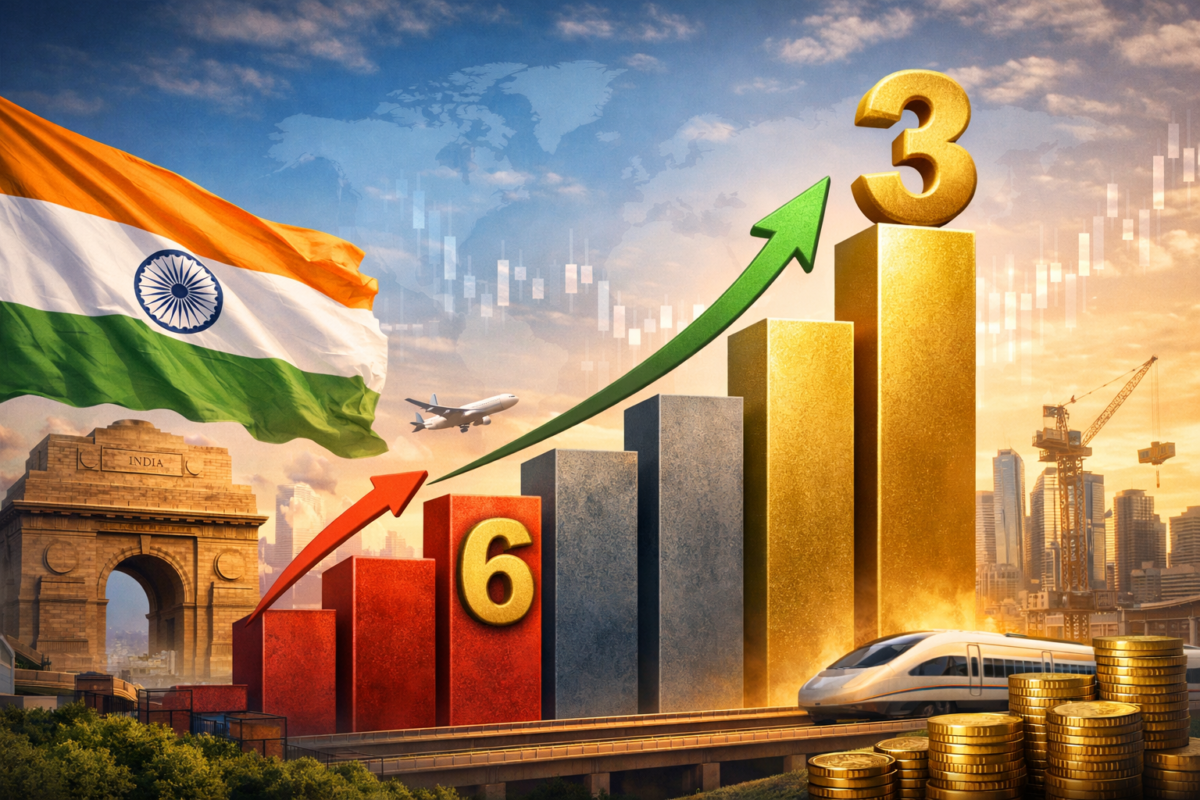
India slipped to 6th economy in 2025 due to currency and global factors. Explore key reasons, growth drivers, and why India may become the 3rd largest economy by 2031. India’s economic journey has been one of resilience and rapid expansion over the past decade. However, recent global estimates indicate that India has slipped to the sixth-largest economy in 2025. While this may raise concerns at first glance, a deeper analysis reveals that this shift is more of a temporary fluctuation than a long-term setback.
India’s Current Economic Position
In 2025, India’s nominal GDP is estimated to be close to $3.9 trillion, placing it behind economies like the United Kingdom and Japan. This marks a slight decline from its earlier position as the fifth-largest economy globally.
However, it is important to understand that global rankings are based on GDP measured in US dollars. This means that even minor currency fluctuations can significantly influence a country’s position without reflecting actual domestic economic performance.
Table of Contents
India Slipped to 6th Economy – Key Reasons Behind the Ranking Shift
Currency Depreciation
One of the primary factors contributing to India’s drop in ranking is the depreciation of the Indian rupee against the US dollar. Since GDP comparisons are calculated in dollar terms, a weaker rupee reduces the overall size of the economy in global rankings, even if growth remains stable domestically.
Statistical Adjustments
Revisions in GDP data and updates in calculation methodologies have also impacted India’s position. These adjustments can lead to changes in nominal GDP figures, affecting rankings without indicating a slowdown in real economic activity.
Close Competition Among Major Economies
India’s GDP is closely comparable to that of the UK and Japan. Small changes in growth rates or exchange rates can easily shift rankings among these economies, making such movements relatively common.
Strong Economic Fundamentals Remain Intact
Despite the temporary slip, India continues to be one of the fastest-growing major economies in the world. Its growth is supported by several strong pillars:
Rising domestic consumption
A rapidly expanding services sector
Strong digital infrastructure
Continued policy reforms
India’s economy is steadily moving toward the $4 trillion mark, reinforcing its status as a global economic powerhouse.
Future Outlook: A Promising Trajectory
Short-Term Recovery
Economic projections suggest that India is likely to regain its position among the top five economies in the near future. As growth continues and currency stability improves, the country is expected to climb back in global rankings.
Long-Term Goal: Third-Largest Economy
Looking ahead, India is projected to become the third-largest economy in the world by 2031. This milestone would place it behind only the United States and China, marking a significant achievement in its growth journey.
India Slipped to 6th Economy – Key Drivers of Future Growth
Demographic Advantage
India’s young and growing population provides a strong workforce, which is essential for sustained economic expansion and innovation.
Digital Revolution
The rapid adoption of digital technologies, including fintech, e-commerce, and digital payments, is transforming the economy and creating new growth opportunities.
Read Also – US Won’t Repeat China Trade Mistake With India: What It
Infrastructure Development
Large-scale investments in roads, railways, and logistics are enhancing connectivity and boosting productivity across sectors.
Policy and Reform Initiatives
Government efforts to improve the ease of doing business, attract foreign investment, and promote manufacturing are strengthening the overall economic framework.
Challenges to Address
While the outlook remains optimistic, certain challenges need attention to sustain long-term growth:
Currency volatility
Global economic uncertainties
Export competitiveness
Income inequality
Addressing these issues will be crucial for maintaining momentum and achieving future targets.
India Slipped to 6th Economy – What This Means for India
India’s slip to the sixth position should not be viewed as a decline in economic strength. Instead, it reflects the dynamic nature of global economic rankings, where external factors like currency movements can influence outcomes.
The country’s strong fundamentals, combined with consistent growth and strategic reforms, indicate that India remains on a solid path toward long-term economic leadership.
Conclusion
The shift in India’s global economic ranking in 2025 is a temporary phase rather than a permanent setback. Backed by robust growth drivers and a clear vision for the future, India is well-positioned to reclaim its position among the top economies.
With continued progress, innovation, and policy support, the country is not only expected to bounce back but also emerge as the third-largest economy in the world by 2031. India’s growth story is far from over—it is still unfolding, with even greater milestones ahead.






[…] Read Also – Why India Slipped To 6th Economy And Growth Outlook To 2031 […]
[…] Read Also – Why India Slipped To 6th Economy And Growth Outlook To 2031 […]