

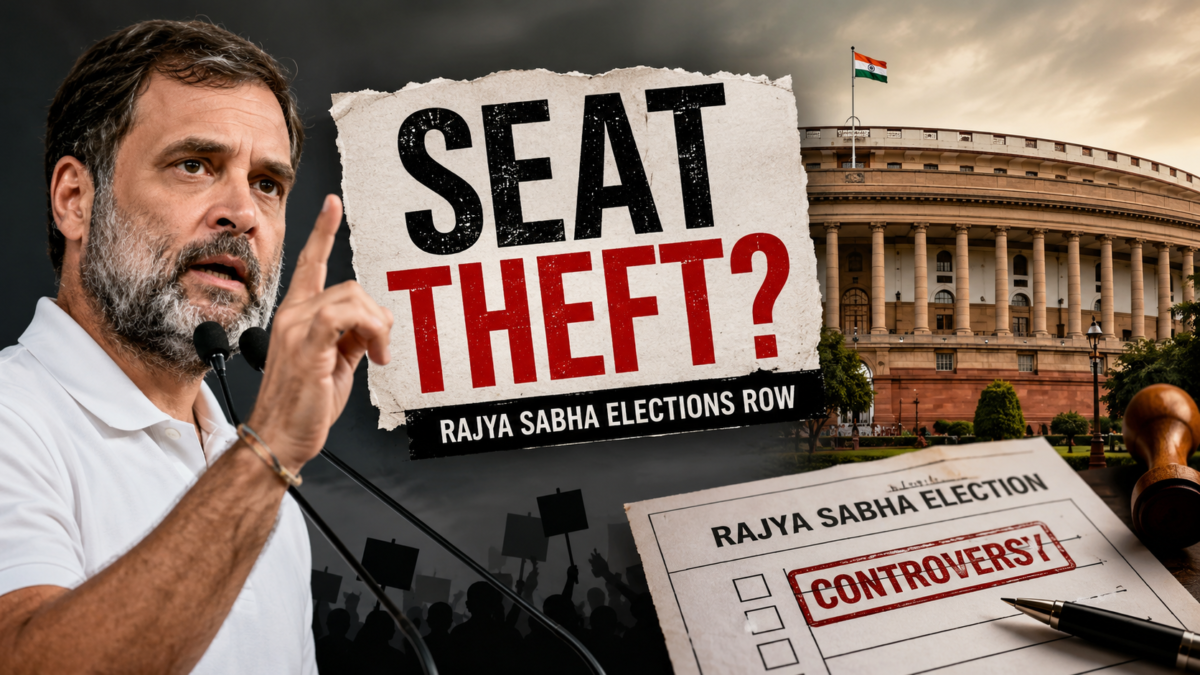
Rahul Gandhi’s ‘Seat Theft’ Claim Sparks Rajya Sabha Row – India’s political landscape has witnessed another round of intense confrontation as allegations surrounding the recent Rajya Sabha elections have triggered a nationwide debate. The controversy emerged after the nomination of an opposition-backed candidate was rejected, leading opposition leaders to question the fairness and transparency of the electoral process.
The development has reignited discussions about democratic institutions, electoral integrity, and the role of constitutional bodies in safeguarding free and fair elections.
What Triggered the Controversy?
The dispute began when an opposition candidate seeking a Rajya Sabha seat was declared ineligible during the nomination process. Opposition parties argued that the candidate had fulfilled all necessary requirements and should have been allowed to contest the election.
Following the rejection, senior opposition leaders accused the ruling establishment of using procedural mechanisms to prevent a competitive election. The issue quickly escalated into a broader political controversy, with both sides presenting sharply contrasting narratives.
While opposition leaders described the incident as an attack on democratic values, the ruling party maintained that all decisions were taken strictly according to established electoral rules and legal provisions.
Table of Contents
Rahul Gandhi’s ‘Seat Theft’ Allegation
Adding further momentum to the debate, Rahul Gandhi alleged that the incident represented a form of “seat theft.” According to him, democracy is weakened when opposition candidates are prevented from participating in elections through procedural decisions.
The remark follows a series of previous accusations made by opposition leaders regarding the functioning of democratic institutions and electoral systems. By introducing the phrase “seat theft,” the opposition has attempted to frame the issue as part of a larger concern about political fairness and democratic accountability.
Supporters of the opposition argue that voters and elected representatives deserve genuine electoral competition. They contend that any action that limits political participation should be carefully scrutinized.
Ruling Party Rejects the Claims
The ruling party has strongly dismissed the allegations, describing them as politically motivated and lacking factual basis. Party leaders insist that election authorities acted within the framework of the law and that the rejection of a nomination should not be interpreted as evidence of wrongdoing.
According to the government’s position, electoral procedures exist to ensure compliance with legal requirements, and every candidate is expected to meet those standards without exception.
Officials associated with the process have also emphasized that electoral decisions are based on rules rather than political considerations.
Questions Around Electoral Transparency
The controversy has once again placed the spotlight on electoral transparency in India. Whenever disputes arise during elections, public attention naturally shifts toward the institutions responsible for administering and monitoring the process.
Political observers note that confidence in democratic institutions is essential for maintaining public trust. Even when decisions are legally justified, clear communication and transparency can help prevent confusion and reduce political tensions.
Many analysts believe that electoral authorities must continue to provide detailed explanations for significant decisions, particularly when those decisions become subjects of national debate.
Why Electoral Integrity Matters
Elections are the foundation of democratic governance. Beyond selecting representatives, they serve as a mechanism through which citizens express their political preferences and hold leaders accountable.
When controversies emerge during the electoral process, they can influence public perception and shape broader discussions about governance and institutional credibility.
Experts often highlight several key principles that strengthen electoral integrity:
Equal Application of Rules
Election laws should be applied consistently to all candidates and political parties.
Transparency in Decision-Making
Authorities should clearly explain major decisions to maintain public confidence.
Institutional Independence
Democratic institutions must remain free from political influence.
Fair Political Competition
A healthy democracy depends on the ability of multiple viewpoints and candidates to compete openly.
Potential Political Impact
The dispute is likely to remain a significant political issue in the coming months. Opposition parties may continue raising concerns about electoral fairness, while the ruling party is expected to defend the legitimacy of the process.
Political analysts suggest that such controversies often extend beyond a single election. They can influence public discourse, campaign narratives, and broader debates about democratic reforms.
Read Also – Delimitation 2026 Explained Lok Sabha Seat Increase & State
As the issue gains attention, calls for greater transparency and institutional accountability may grow stronger. Whether the controversy leads to policy discussions or legal challenges remains to be seen.
Conclusion
The Rajya Sabha election controversy has become more than a dispute over a single nomination. It has evolved into a larger debate about democratic values, electoral transparency, and institutional trust. While the opposition views the incident as evidence of unfair political practices, the ruling party insists that established rules were followed.
As the discussion continues, the focus will remain on ensuring that democratic processes are transparent, credible, and trusted by citizens across the political spectrum. Ultimately, the strength of any democracy depends not only on elections themselves but also on public confidence in the institutions that oversee them.