

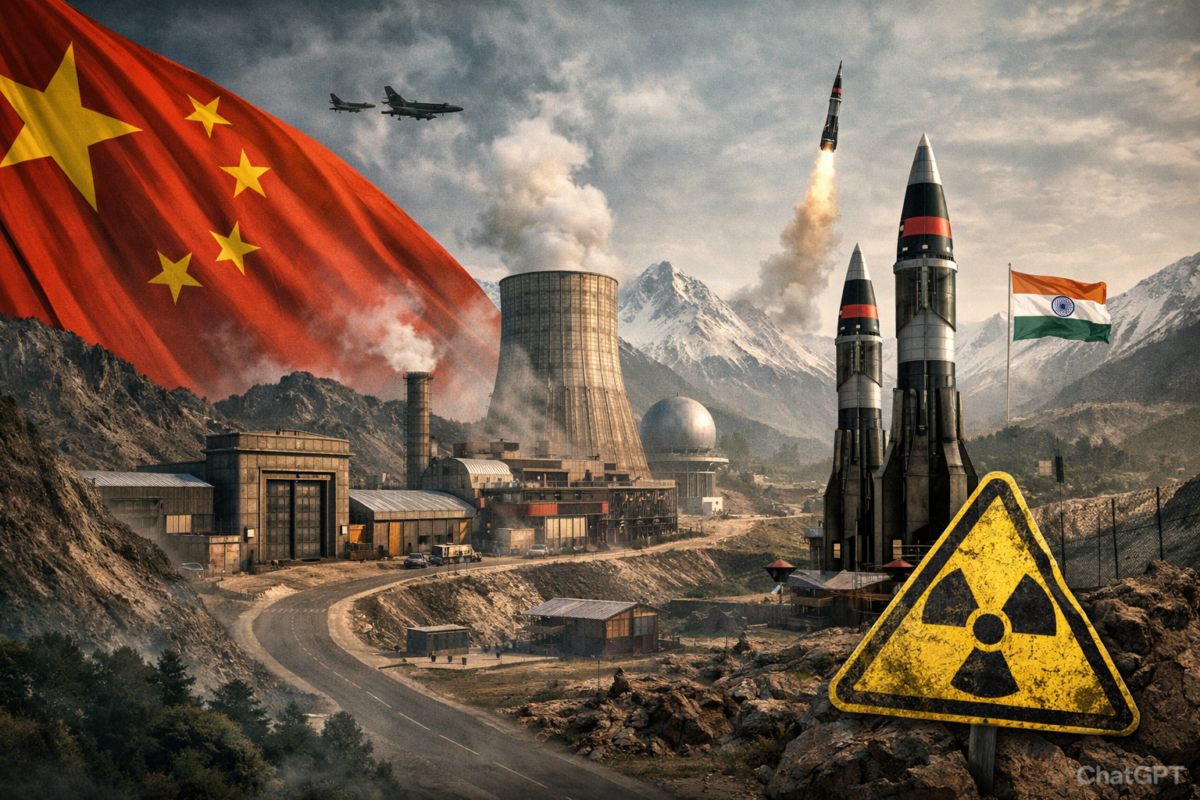
China is reportedly expanding its nuclear weapons infrastructure just 800 km from Arunachal Pradesh. Explore the strategic implications for India, regional security, and Asia’s shifting power balance. Recent strategic assessments suggest that China is accelerating the expansion of its nuclear weapons infrastructure deep within its interior. What makes this development particularly significant for India is the reported proximity of key facilities — roughly 800 kilometres from Arunachal Pradesh.
While the sites are not located directly on the border, their operational capabilities and rapid development indicate a broader shift in regional security dynamics. For policymakers and defence analysts, this expansion represents more than just numerical growth — it signals evolving doctrine, strategic positioning, and long-term geopolitical ambition.
China’s Expanding Nuclear Arsenal: A Rapid Transformation
Over the past decade, China’s nuclear stockpile has grown at a pace that has drawn global attention. Estimates suggest that its total warhead count has crossed 600 and could approach or exceed 1,000 by the end of this decade if current trends continue.
Although still smaller than the arsenals maintained by the United States and Russia, the speed of China’s expansion reflects a clear strategic intent. Rather than maintaining a minimal deterrent posture, Beijing appears to be moving toward a more robust and diversified nuclear capability.
This transformation includes:
Expansion of missile silo fields
Modernization of delivery systems
Development of advanced warhead technologies
Strengthening of inland production and testing infrastructure
The emphasis on survivability and second-strike capability indicates a doctrinal shift aimed at ensuring deterrence credibility in an increasingly complex global security environment.
Table of Contents
Why Inland Facilities Matter
One of the most notable aspects of China’s nuclear expansion is its focus on interior mountainous regions. These areas provide natural protection from aerial surveillance and potential pre-emptive strikes. By situating production and testing facilities far from coastlines and immediate border zones, China enhances the survivability of its strategic assets.
Reports indicate that certain valleys in southwestern China are undergoing significant redevelopment. These sites were historically associated with defence industry operations but now appear to be receiving modern upgrades.
Such locations offer several advantages:
Geographical protection through mountainous terrain
Reduced vulnerability to long-range conventional strikes
Strategic depth in the event of escalation
Operational secrecy due to limited public visibility
This pattern suggests a long-term investment in sustainable warhead production rather than short-term stockpiling.
Testing and Warhead Core Production Capabilities
Satellite observations and defence analyses indicate upgrades consistent with high-explosive testing infrastructure. High explosives play a crucial role in triggering the implosion mechanism of nuclear warheads. Enhancements in this domain typically signal efforts to refine precision and reliability.
Another site reportedly shows signs of plutonium pit production — the central core component of modern nuclear weapons. Facilities with specialized ventilation systems, fortified construction, and secure handling infrastructure often indicate advanced material processing capabilities.
If accurate, these developments suggest that China is not merely expanding its stockpile but also modernizing warhead design and production efficiency. This combination strengthens both the qualitative and quantitative aspects of its nuclear arsenal.
Strategic Implications for India
For India, the proximity of these facilities — approximately 800 km from Arunachal Pradesh — introduces additional layers of strategic consideration. Although the sites are located within Chinese territory and not directly along the Line of Actual Control (LAC), their existence influences broader defence calculations.
- Enhanced Deterrence Pressure
A larger and more technologically advanced Chinese nuclear arsenal strengthens Beijing’s strategic leverage. Even without direct deployment near the border, expanded production capacity enhances overall deterrence posture.
- Multi-Domain Military Planning
India must now consider not only conventional border dynamics but also evolving nuclear modernization trends. This could influence:
Missile defence planning
Early warning systems
Intelligence and satellite monitoring
Strategic command preparedness
- Regional Power Balance
An expanded Chinese arsenal reshapes Asia’s security environment. As one of the region’s major powers, India must calibrate its deterrence strategy to maintain credible balance while avoiding destabilizing escalation.
Read Also – Pam Bondi Congressional Hearing Explained Epstein Files
The Broader Regional and Global Context
China’s nuclear expansion is not occurring in isolation. Global arms control mechanisms have weakened in recent years, and major treaties limiting nuclear arsenals have either lapsed or narrowed in scope.
Without inclusive multilateral agreements, nuclear modernization programs continue largely unchecked. The absence of transparency mechanisms increases uncertainty, which can drive worst-case scenario planning among rival states.
In Asia, this dynamic could influence:
Defence spending trajectories
Strategic partnerships
Missile development programs
Nuclear policy debates
While China maintains that its posture remains defensive, the scale and pace of expansion inevitably attract scrutiny.
A Shift in Strategic Doctrine?
Traditionally, China has adhered to a doctrine of minimum deterrence and a declared no-first-use policy. However, the acceleration of silo construction, warhead production capabilities, and delivery system modernization has led analysts to question whether the doctrine is evolving toward a more flexible or expansive framework.
The move toward hardened inland production sites indicates a focus on survivability and long-term resilience. This suggests that Beijing is preparing for a future strategic environment defined by heightened competition among major powers.
Conclusion: Navigating a Changing Security Landscape
China’s quiet yet substantial nuclear infrastructure expansion marks a pivotal moment in Asia’s strategic landscape. The development of inland production and testing facilities near India’s northeastern frontier underscores the need for careful assessment and calibrated policy responses.
For India, the challenge lies in balancing vigilance with stability — strengthening deterrence without triggering unnecessary escalation. For the broader international community, the trend highlights the urgent need for renewed dialogue on arms control, transparency, and strategic risk reduction.
As geopolitical competition intensifies, nuclear modernization programs will remain central to global security calculations. Understanding these shifts today is essential for managing the strategic realities of tomorrow.






[…] Read Also – China Expands Nuclear Arsenal Near Arunachal Pradesh […]