

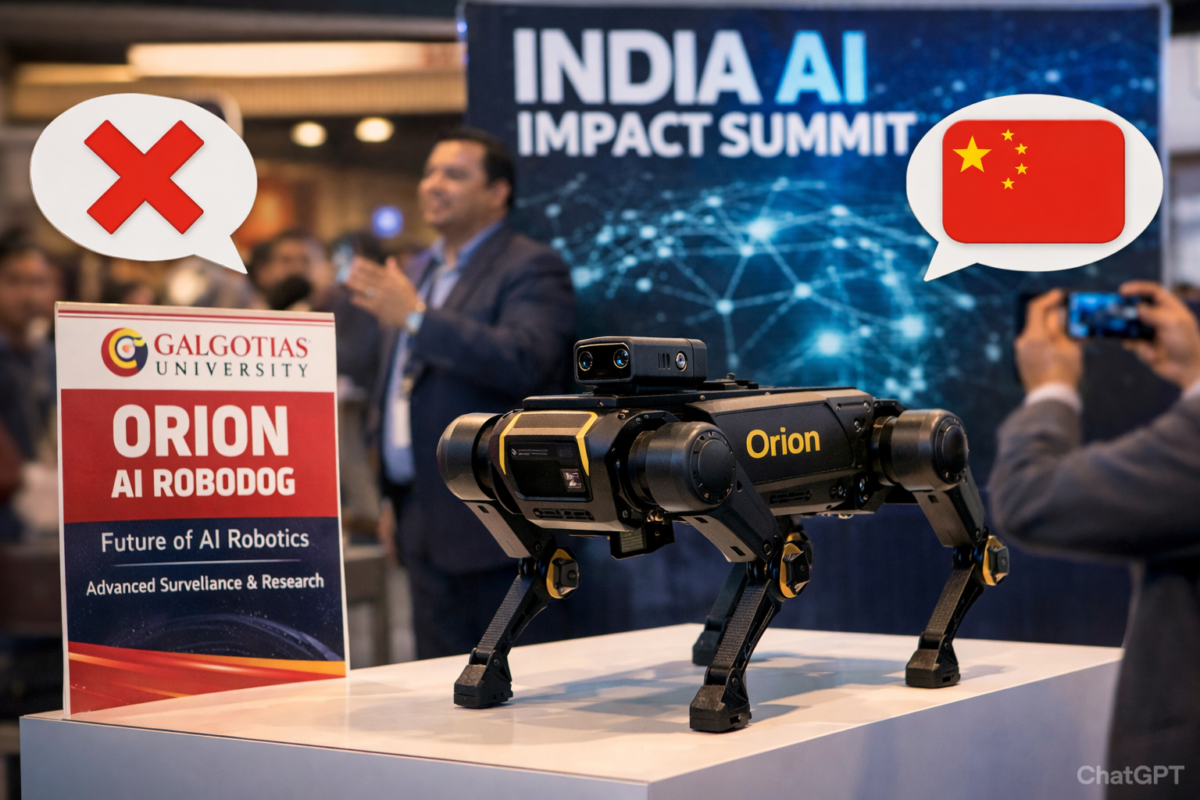
Galgotias University faced backlash after showcasing a Chinese robodog at an AI summit. Here’s what happened, the official clarification, and why transparency in AI exhibitions matters. A recent showcase at an AI summit sparked widespread debate after Galgotias University faced criticism for displaying a robotic dog that many believed was being presented as an in-house innovation. The controversy quickly gained traction online, raising important questions about transparency, technology sourcing, and how institutions communicate their AI capabilities.
Here’s a detailed breakdown of the incident, the clarification issued, and what it means for the future of AI showcases in India.
Galgotias University – The AI Summit Showcase That Triggered Debate
During a major AI summit held in Delhi, the university displayed a robotic dog named “Orion” as part of its broader artificial intelligence initiatives. The institution has previously highlighted significant investments in AI research, infrastructure, and innovation centers.
At the event, representatives demonstrated the robotic dog’s capabilities, including mobility, surveillance potential, and smart automation features. Videos of the demonstration quickly circulated on social media platforms, drawing attention from technology enthusiasts and industry observers.
However, what initially appeared to be a showcase of advanced institutional research soon turned controversial.
Table of Contents
The Robodog’s Origin: Imported Technology?
Soon after the videos went viral, online users began pointing out that the robotic dog closely resembled the Go2 model developed by Unitree Robotics. The product is commercially available and widely used for research, industrial inspection, and educational demonstrations around the world.
This led to speculation that the robot may not have been developed by the university itself. Critics argued that if the device was imported or purchased off-the-shelf, it should have been clearly presented as such during the exhibition.
The discussion intensified because the showcase was linked to substantial AI investment claims. Some users questioned whether the messaging created an impression that the robot was an original in-house innovation rather than a sourced educational tool.
Official Clarification from the University
Following the online backlash, the university issued a formal clarification. The institution stated that it had neither built nor claimed to have built the robotic dog. According to its statement, the device was acquired from a global technology provider strictly for academic and demonstration purposes.
The university emphasized that such equipment is used to provide students with hands-on exposure to cutting-edge robotics systems. The objective, it clarified, was to help learners understand AI-driven mobility, real-time data processing, and automation systems in practical settings.
The statement further explained that educational institutions often source advanced technologies from global markets to enrich research and classroom learning experiences.
Why Transparency Matters in AI Exhibitions
The controversy highlights a broader issue: how emerging technologies are presented at public platforms.
In today’s digital ecosystem, where information spreads instantly, even minor ambiguities can escalate into reputational challenges. When institutions participate in high-profile technology events, clarity about what is developed in-house versus what is sourced externally becomes critical.
- Clear Attribution Builds Trust
Audiences expect transparency, especially in fields like artificial intelligence where innovation claims carry significant weight. Clear labeling of sourced technologies helps maintain credibility.
- Managing Public Perception
India is rapidly positioning itself as a global AI hub. In this environment, claims of indigenous development are closely scrutinized. Any confusion can quickly trigger skepticism.
- Educational Tools vs. Proprietary Innovation
There is a clear difference between using commercially available tools for academic learning and claiming proprietary technological breakthroughs. Institutions must communicate that distinction effectively.
The Growing AI Landscape in India
India’s AI ecosystem has seen rapid expansion in recent years. From startups to academic institutions, investments in machine learning, robotics, and automation research are increasing significantly.
Cities such as Greater Noida have emerged as education and technology hubs, hosting institutions that actively participate in national and international tech events. Meanwhile, India continues to promote AI-driven innovation through policy initiatives and industry partnerships.
Against this backdrop, expectations are high. Institutions showcasing AI systems are often perceived as contributors to indigenous innovation. As a result, clarity in communication becomes even more important.
Read Also – Trisha Krishnan Issues Strong Warning Against Disrespectful
Lessons for Universities and Tech Institutions
The robodog episode offers valuable lessons for educational institutions, research centers, and technology exhibitors.
Be Explicit About Technology Sources
If a device is imported or commercially purchased, clearly state it. There is no reputational risk in using global technology—lack of transparency is what creates problems.
Avoid Ambiguous Language
Words like “our innovation” or “developed by us” should only be used when entirely accurate. Precision in language can prevent misunderstandings.
Highlight Educational Impact
If the purpose of the technology is to provide students with hands-on training, make that the central narrative. Demonstrating how students are learning to program, modify, or integrate such systems can be more impactful than implying ownership.
The Bigger Takeaway
At its core, this controversy was less about a robotic dog and more about perception. In the fast-evolving world of artificial intelligence, credibility is everything. Institutions must balance ambition with authenticity.
Showcasing advanced robotics like the Unitree model can absolutely enhance learning environments. However, in an era where digital audiences analyze every detail, communication strategies must be as sophisticated as the technology being displayed.
As AI continues to reshape industries and education systems, transparency will remain a cornerstone of trust. The recent episode serves as a timely reminder that innovation is not only about building technology—it is also about clearly communicating its origins, purpose, and impact.
Final Thoughts
The robodog controversy underscores the importance of responsible representation in the AI era. Educational institutions play a crucial role in shaping the next generation of innovators. With that responsibility comes the need for clarity, precision, and accountability in public showcases.
As India strengthens its position in the global AI race, moments like these will shape how institutions refine their messaging and presentation strategies moving forward.