

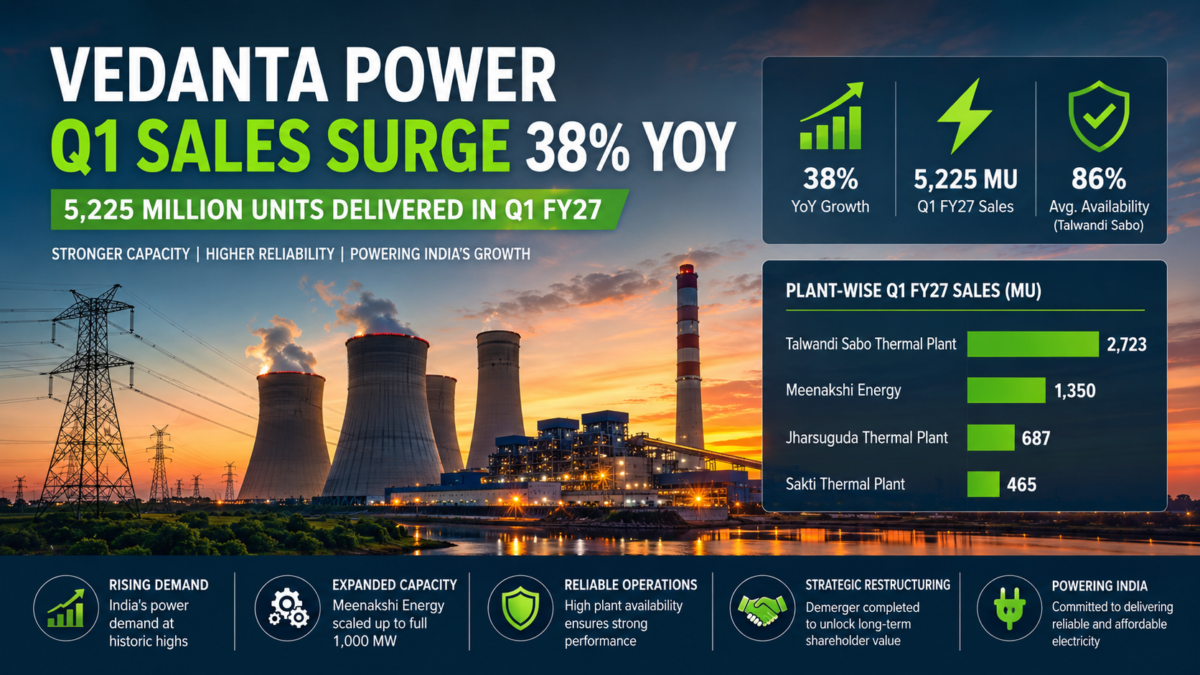
Discover how Vedanta Power achieved a 38% YoY rise in Q1 sales to 5,225 million units, driven by Meenakshi Energy’s massive capacity expansion. As India’s power demand reaches historic highs, major energy players are restructuring and expanding to meet the country’s soaring electricity needs. Vedanta Power Limited has set a strong tone for the fiscal year 2026-27, registering an impressive 38% year-on-year (YoY) increase in electricity sales during the first quarter. In total, the utility distributed 5,225 million units (MU) of electricity for the three-month period ending June 30, 2026. This significant growth highlights the impact of aggressive capacity expansions, despite minor sequential operational setbacks and corporate transitions.
Let’s deep dive into Vedanta Power’s Q1 performance, examining individual power plants, corporate demergers, and future insights for energy sector investors and analysts.
Corporate Restructuring and the Demerger Context
A crucial aspect of evaluating Vedanta Power’s Q1 performance is the company’s recent structural evolution. During this quarter, Vedanta Power successfully completed its demerger from its parent conglomerate, demerged from Vedanta Limited. This major transition means that the reported Q1 FY27 figures cover both pre-demerger and post-demerger operational phases.
Consequently, financial analysts and industry observers should view historical year-on-year comparisons with this context in mind. By separating its power generation business into a dedicated, standalone entity, Vedanta Power aims to optimize capital allocation and unlock long-term shareholder value.
Plant-by-Plant Analysis of Vedanta Power’s Q1 Sales
Meenakshi Energy: The Star Performer
The primary driver behind Vedanta Power’s outstanding 38% year-on-year jump was Meenakshi Energy. The subsidiary recorded a stellar sales figure of 1,350 MU for the quarter. This represents an incredible 245% increase compared to the 391 MU registered in the same quarter last year. It also showed a healthy 16% rise sequentially from 1,161 MU in Q4 FY26.
Table of Contents
This monumental surge in output is attributed to Meenakshi Energy’s expanded operational footprint. During Q1 FY26, the facility operated using a single 300 MW unit. Today, the facility has successfully scaled up to its full 1,000 MW capacity, allowing it to feed substantial amounts of power directly into India’s national grid.
Talwandi Sabo: Solid Stability and Punjab PPA Compliance
The Talwandi Sabo Thermal Plant remained the largest volume contributor to Vedanta Power’s overall portfolio. It achieved power sales of 2,723 MU in Q1 FY27, which is remarkably stable when compared to the 2,715 MU recorded in the prior year’s corresponding quarter. On a quarter-on-quarter basis, Talwandi Sabo saw a robust 14% improvement over the 2,386 MU sold in Q4 FY26.
Additionally, the plant’s availability factor reached 86% during the quarter. While this is slightly lower than the 90% recorded in the previous year, it is a massive improvement from the 77% achieved in Q4 FY26. Because Talwandi Sabo’s Power Purchase Agreement (PPA) with the state government of Punjab guarantees compensation based on a normative plant availability threshold of 80%, the plant’s 86% performance ensures optimal financial returns and regulatory compliance.
Sakti Thermal Plant: Navigating Temporary Technical Setbacks
The Sakti Thermal Plant (previously known as the Athena Power Plant) recorded Q1 FY27 sales of 465 MU. While the plant had zero sales during the same quarter of the previous year, its sequential performance saw a sharp 57% drop compared to the 1,087 MU sold in Q4 FY26.
This decline was primarily due to an unfortunate technical outage. On April 14, 2026, the plant suffered a major boiler incident that forced a temporary shutdown. Operations at the facility remained suspended for the rest of the quarter as engineering teams focused on safety protocols and rehabilitation.
Jharsuguda Thermal Plant: Minor Gains and Improved Reliability
The Jharsuguda Thermal Plant posted power sales of 687 MU for Q1 FY27. This represents a modest 1% increase over the 678 MU sold in Q1 FY26, though it fell 23% sequentially from 896 MU.
Despite the flat year-on-year sales, Jharsuguda’s structural health improved dramatically. Its plant availability factor surged to 93%, compared to a dismal 66% in Q1 FY26. This high availability indicates excellent operational reliability, positioning the plant for higher output as demand increases in the coming quarters.
Understanding India’s Power Demand and the Industry Outlook
Vedanta Power’s Q1 sales surge occurs at a time when India’s power demand is reaching unprecedented levels. This is driven by rapid industrialization, intense seasonal heat, and surging commercial activity. For energy sector stakeholders, the key takeaway is the absolute necessity of capacity reliability.
As India seeks to balance its thermal base-loads with green energy integration, plants with high availability and expanded capacity—like Meenakshi Energy—will remain highly profitable. Investors should closely monitor how Vedanta Power resolves the boiler incident at the Sakti Thermal Plant, as bringing this asset back online will serve as another powerful revenue catalyst.
Frequently Asked Questions (FAQs)
Why did Vedanta Power experience a sequential decline in Q1 sales compared to Q4?
While year-on-year sales rose 38%, sequential sales fell 6% due to the temporary shutdown of the Sakti Thermal Plant after a boiler incident on April 14, 2026, alongside seasonal maintenance schedules across other facilities.
What is the significance of the 80% normative availability for Talwandi Sabo?
The plant’s Power Purchase Agreement (PPA) with the Punjab government compensates the utility based on maintaining an 80% availability factor. Operating at 86% during Q1 FY27 ensures Vedanta Power receives full capacity charges and remains highly profitable.
Read Also – SpaceX IPO Explained: Why It Not Deliver Expected Return
How did Meenakshi Energy achieve a 245% increase in YoY sales?
Meenakshi Energy expanded its active generation capacity from a single 300 MW unit in the previous year to its full 1,000 MW capacity, driving the exponential increase in power generation and sales.
About the Author / Expert Contributor
Marcus Vance is a Senior Energy Markets Analyst with over 12 years of experience specializing in the South Asian power, utilities, and infrastructure sector. He tracks corporate mergers, policy shifts, and capacity generation metrics for leading financial publications.
Conclusion
Vedanta Power’s strong Q1 FY27 results prove that strategic capacity expansion is key to navigating India’s soaring energy needs. What are your thoughts on Vedanta Power’s recent demerger and its growth outlook? Let us know in the comments below, and share this post with your network!






[…] Read Also – Vedanta Power Q1 Sales Surge 38% YoY To 5,225 Million Units […]